Fältjournalen
Offline-first military medical record system, developed as a CivTAK plugin
- Role
- Product designer & project lead
- Organisation
- SAF / STRILAB
- Scope
- Part-time
- Timeframe
- 2026–ongoing
- Team
- Project team
- Deliverable
- CivTAK plugin
- Problem
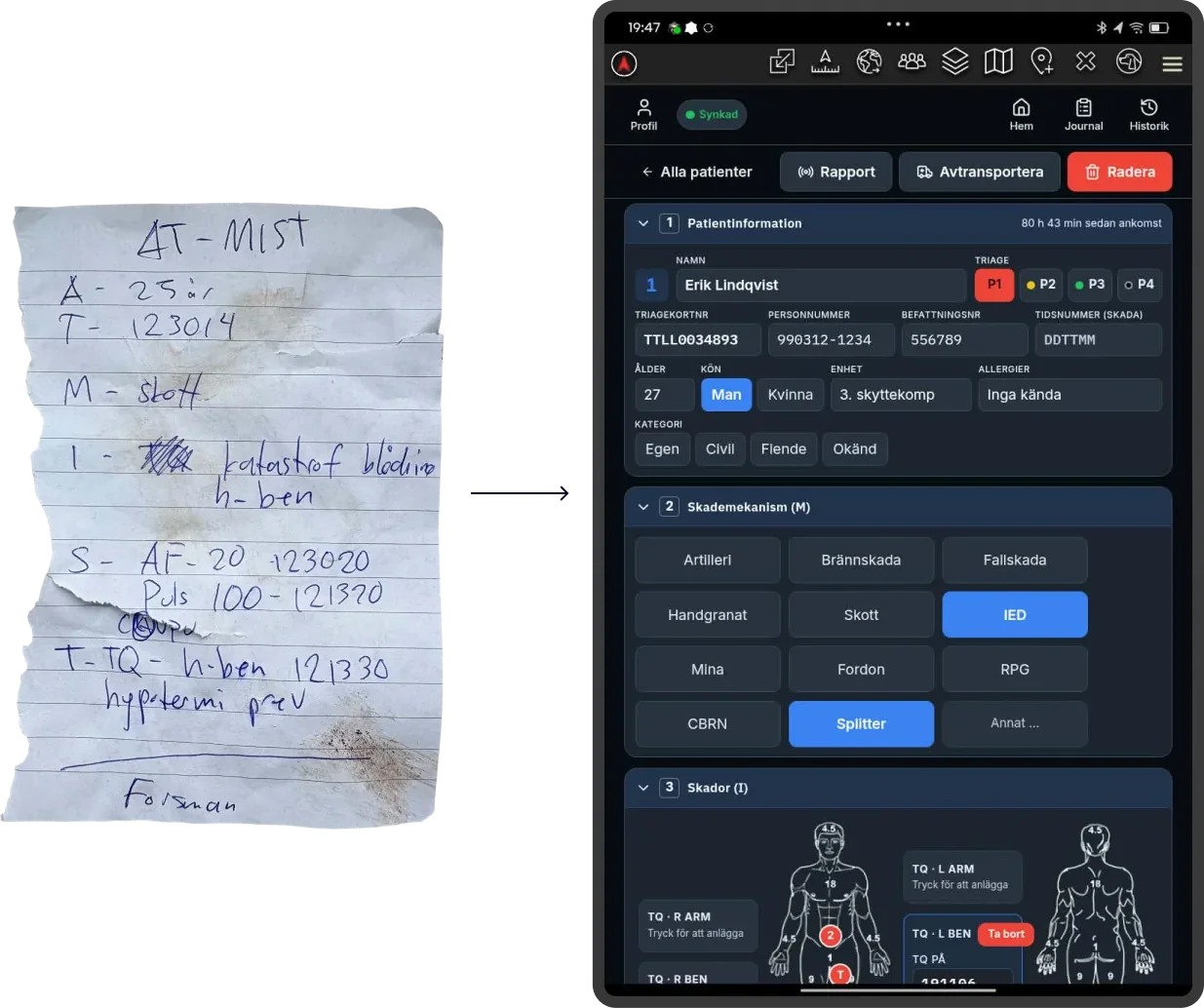
- Medical documentation in the field is done on paper that becomes illegible, incomplete or lost along the way.
- My role
- During STRILAB I was responsible for user testing and the first design. Since then I have handled design, development and customer contact.
- What I did
- 9 interviews, three rounds of testing from paper to MVP, and a CivTAK plugin that works offline.
- Result
- With Fältjournalen, 10 out of 11 could say when the tourniquet was applied, compared with 1 out of 11 on paper, where the information was only on one card. A situational picture in 7.4 seconds instead of 5–30 minutes.
01 Problem
All medical documentation in the field is done on paper today. The note becomes hard to read, incomplete or lost along the evacuation chain, and when the information doesn’t follow the patient, care gets worse. A study from Ukraine (2023–2024) shows how big the problem is:
Source: Ukrainian study on documentation of the wounded during medical evacuation (DOAJ) ↗
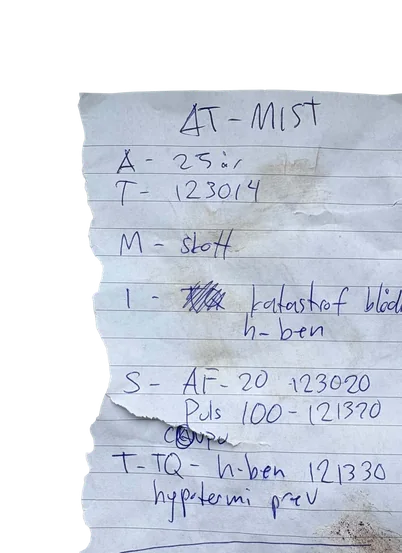
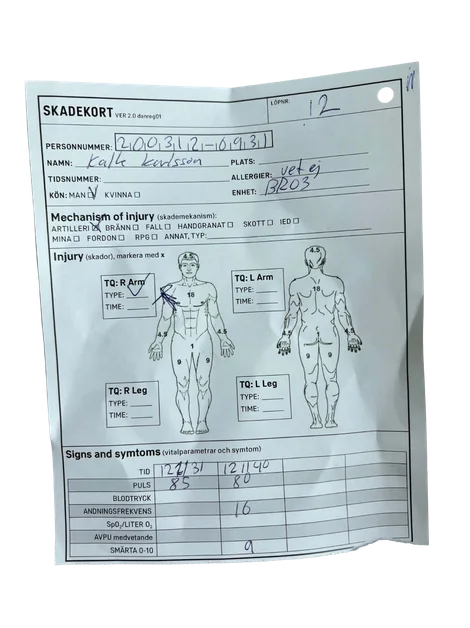
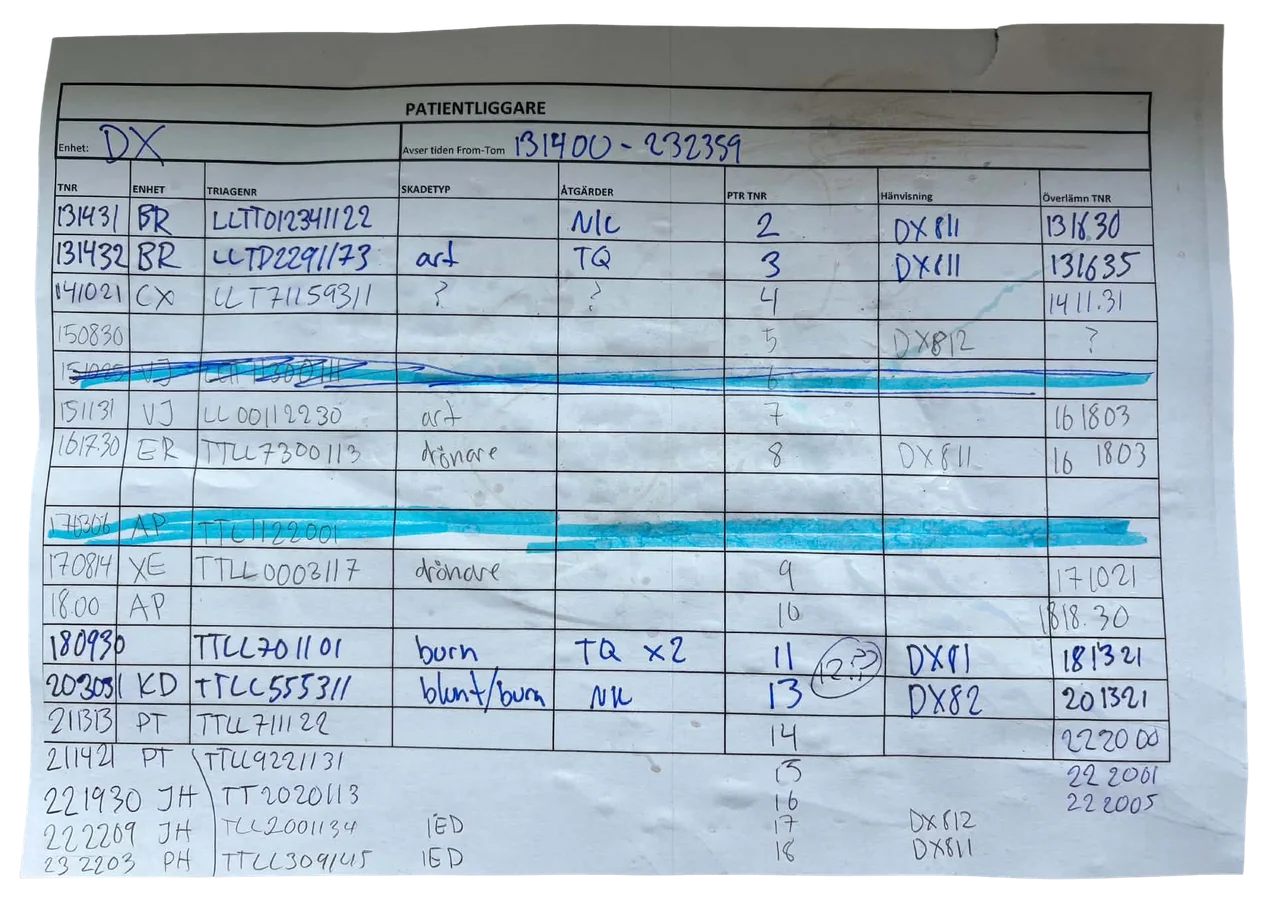
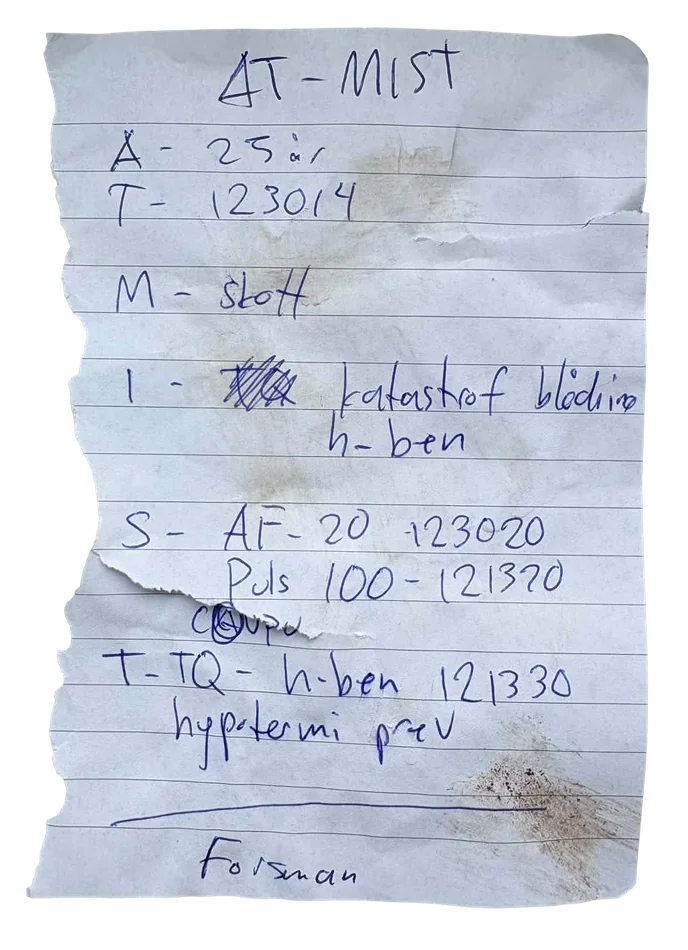
Today’s patient documentation
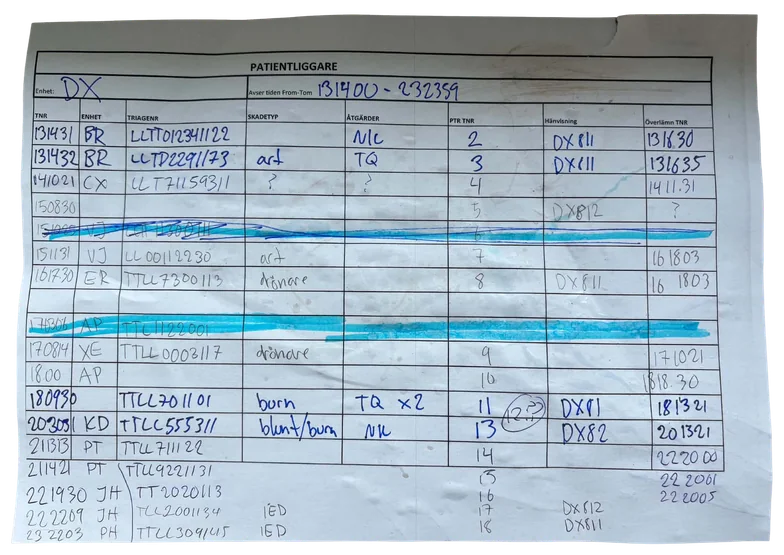
Today’s patient log
02 Discovery
During STRILAB, the Swedish Armed Forces’ first innovation programme, we went from need to field-tested prototype in five weeks. The programme combines Lean Startup with military planning and execution models, and the project was run by me and co-founder Carl Lindén.
Interviews
9 in-depth interviews based on The Mom Test, with Ukraine veterans, civilian healthcare staff and military medics.
Mapping
The core problem wasn’t filling in the card, but that the information doesn’t follow the patient between levels of care.
Design direction
Structured data that follows the casualty all the way.
03 User testing
We tested in three rounds, from paper to a working app, with more users and more realistic scenarios each time.
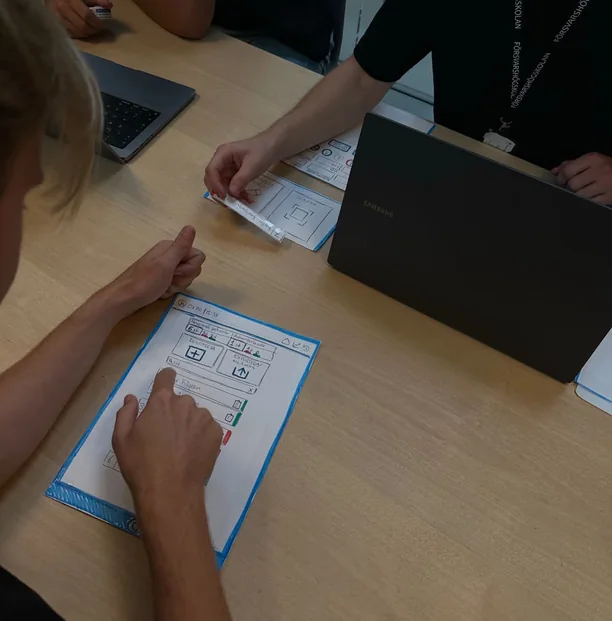
LoFi paper prototype
Three people completed a user test with a paper prototype to validate the information flow.
- 3participants
- 4tasks
- 2misclicks in total
- 100%success rate
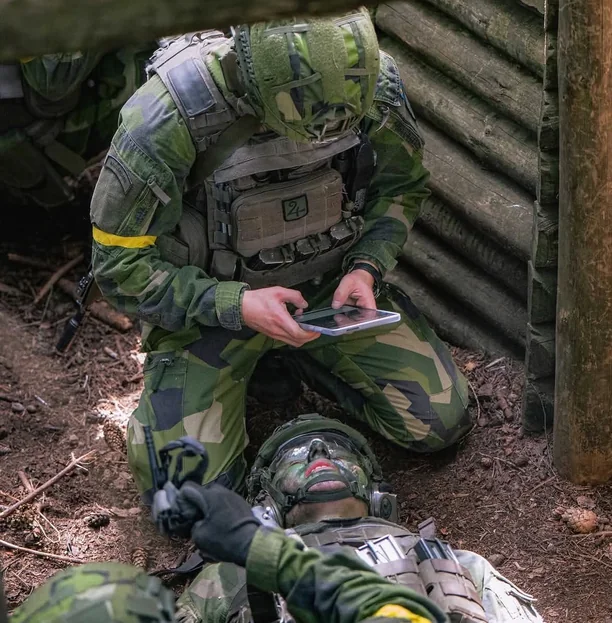
POC
First test with real users in a realistic scenario, using a web prototype.
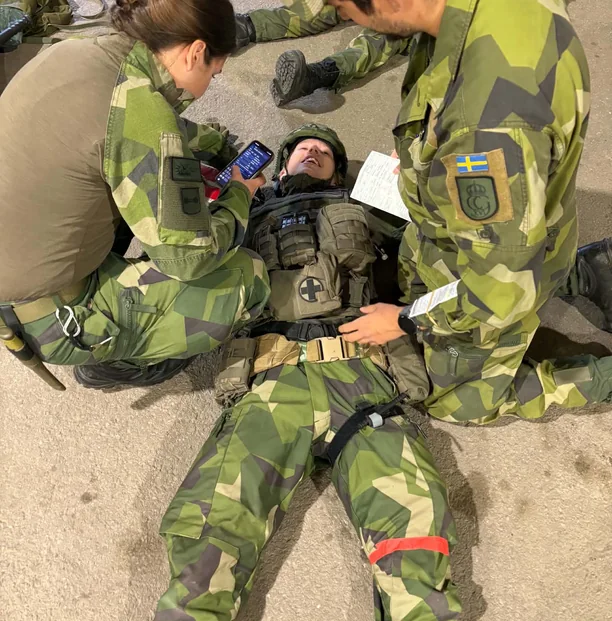
MVP
The MVP was tested in a larger realistic scenario with casualty exercises and 11 soldiers as participants.
Could recall patient data an hour later
76.6
System Usability Scale (SUS), good usabilityLow
04 From prototype to product
Fältjournalen is based on the TCCC card (DD Form 1380). We made a digital version of it and adapted it to how the card is used in the field. It is built as a plugin in CivTAK, works fully offline and syncs as soon as there is a network.
CivTAK: The Swedish Armed Forces have many command and control systems. We chose the one we knew best to make progress, and a system already in use lowers the barrier.
The TCCC card: An established standard that medics already know, so we digitised its structure instead of inventing a new one.
The data’s journey through the chain of care
With a server, several medics can document the same patient in real time, and all patients are gathered in a shared record. No data is lost, not even when the patient is evacuated without a physical handover, for example by unmanned vehicles.
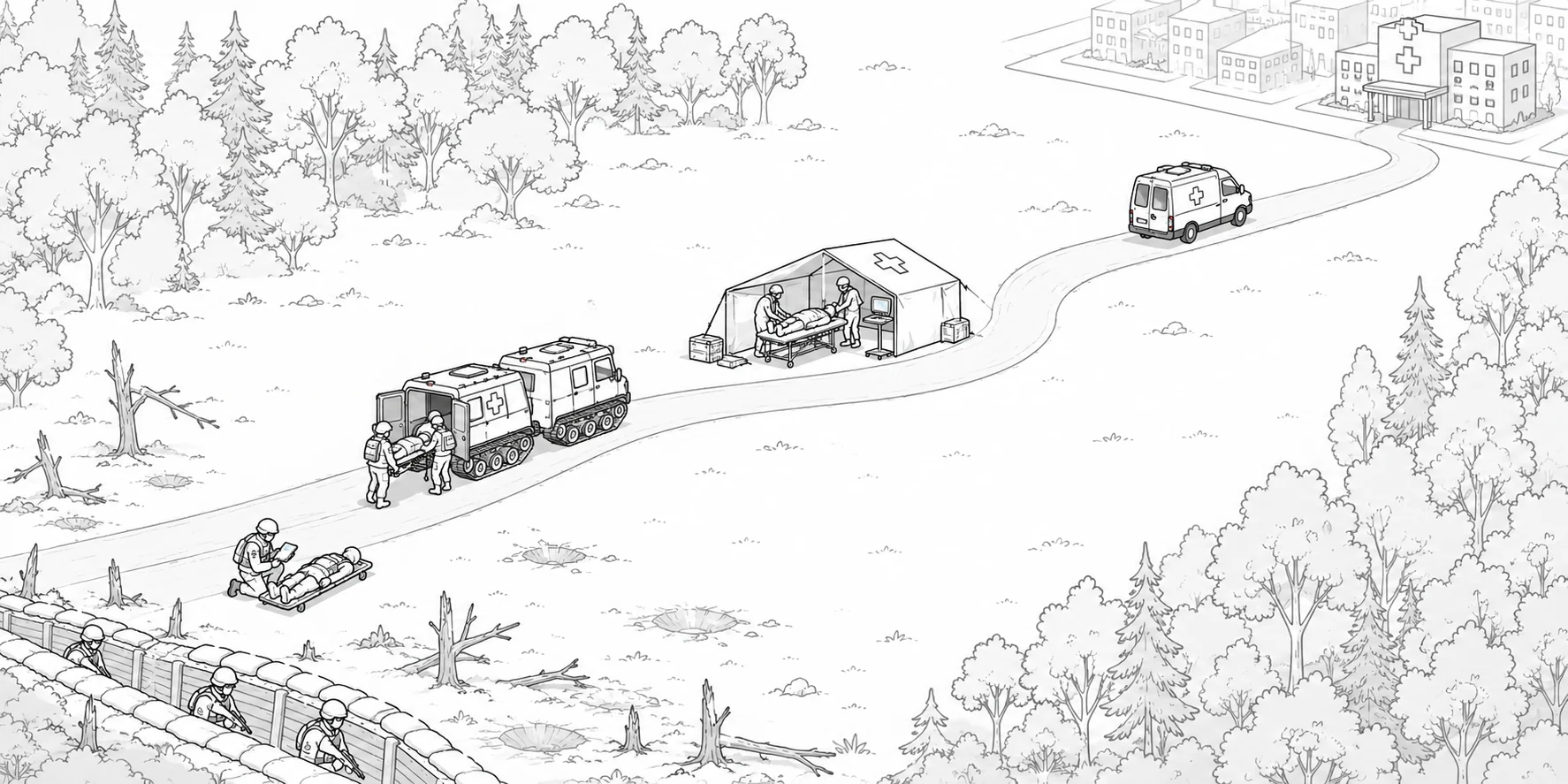
Front. The medic documents at the point of injury.
Evacuation. The record travels with the vehicle.
Aid station. Several medics can work in the same record.
Transport. The record follows the patient onwards.
Hospital. Next step: integration with civilian records systems.
No physical handover. Via server when a physical handover isn’t possible, e.g. evacuation by UGV.
- 1
Front. The medic documents at the point of injury.
- 2
Evacuation. The record travels with the vehicle.
- 3
Aid station. Several medics can work in the same record.
- 4
Transport. The record follows the patient onwards.
- 5
Hospital. Next step: integration with civilian records systems.
No physical handover. Via server when a physical handover isn’t possible, e.g. evacuation by UGV.
Three ways to transfer
At first, data could only be transferred online or by QR code. The field test showed that the QR code became cluttered when the patient had a lot of data, and in sunlight it sometimes couldn’t be scanned. So we added direct Wi-Fi.
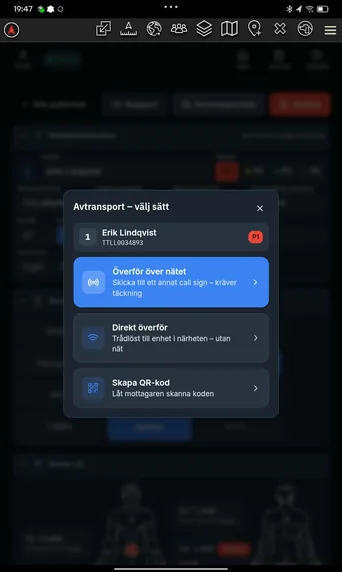
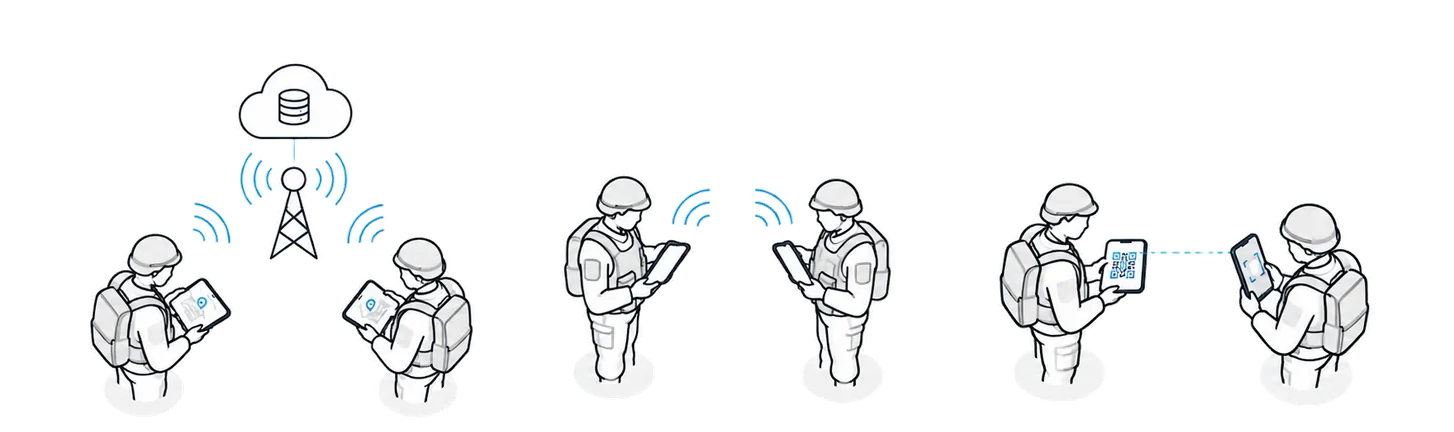
- Online via ATAK serverFastest and the first choice, when there is a network.
- Direct Wi-FiWithout a network, between devices close to each other. Also handles patients with a lot of data.
- QR codeThe last resort. Needs no network or connection between devices.
05 Design decisions & solution
Everything is built to work with gloves on, on the move and under stress: large buttons, clear contrasts and a consistent design language.
Home screen
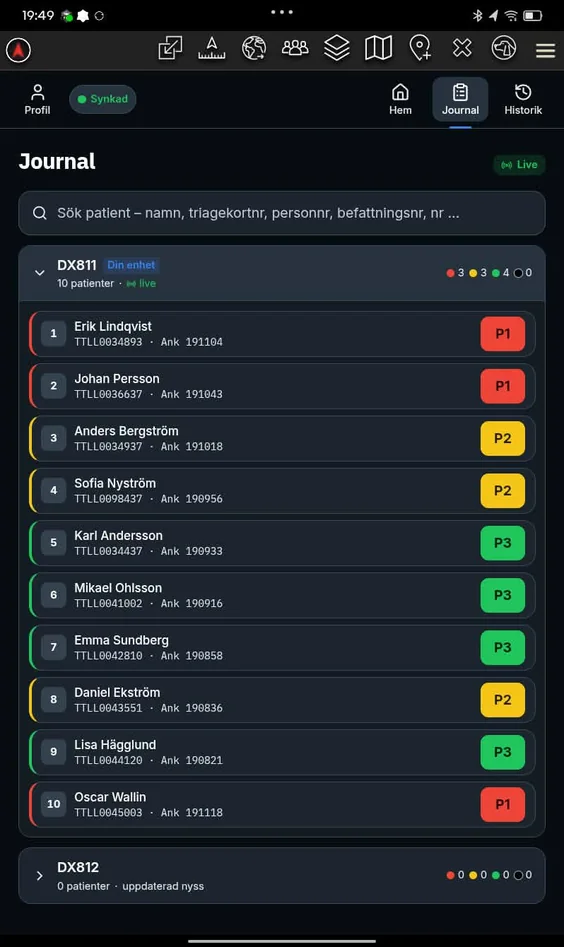
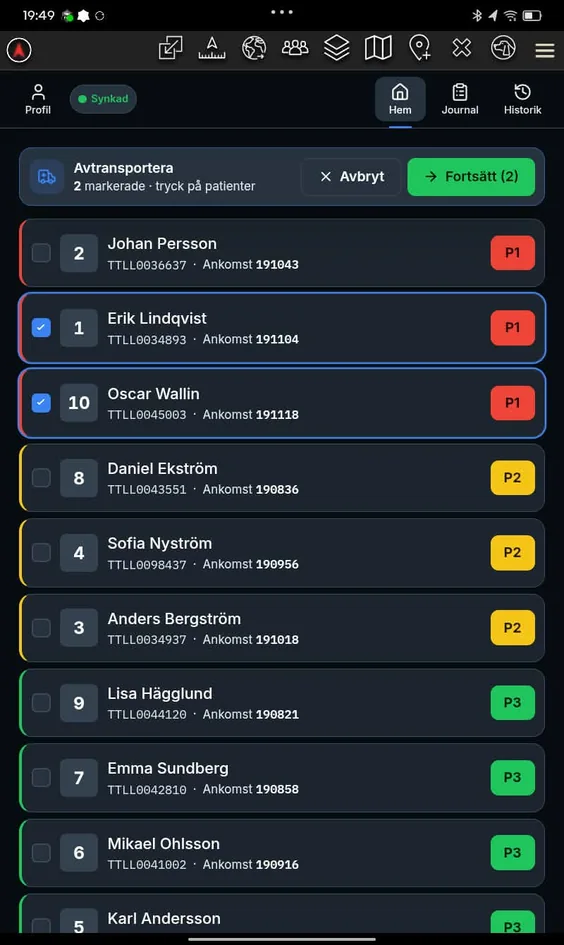
The home screen replaces the handwritten patient log and shows the situation in real time. During user testing, we measured how long it took the medical lead to answer how many casualties were on site and how many had been transported onwards.
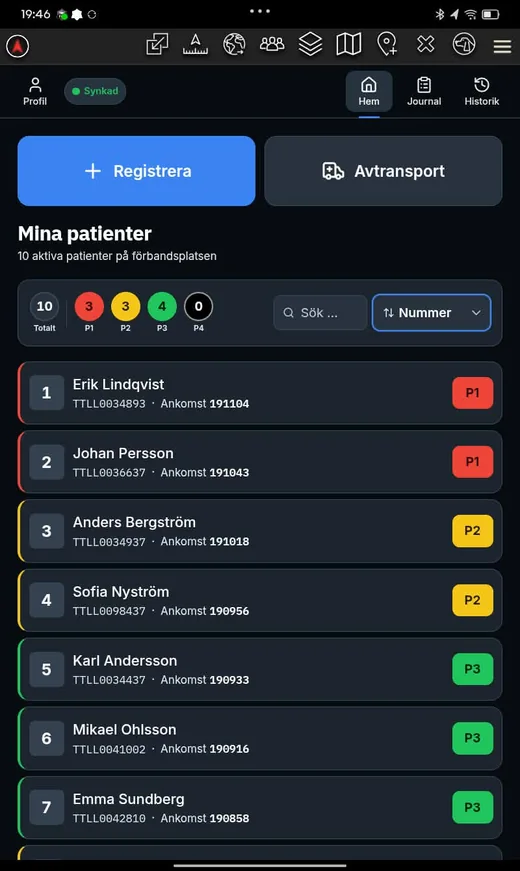
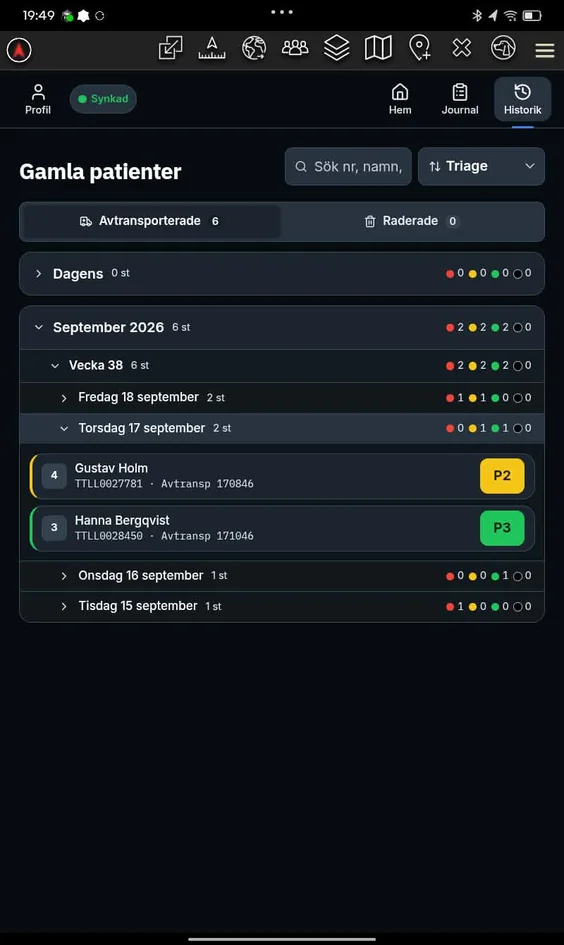
- History See your evacuated patients.
- Real-time updates Your current patients update instantly.
- Filter For example to see who has been at this unit the longest.
- Patient log Tap a patient to open their documentation.
Documentation
The digital casualty card has the same structure as the paper card, but it is legible, makes it possible to document more, and follows the patient all the way.
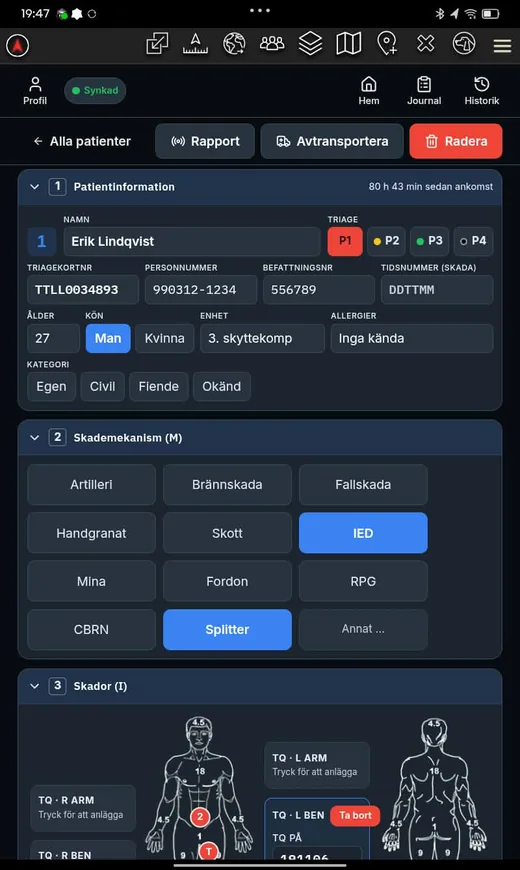
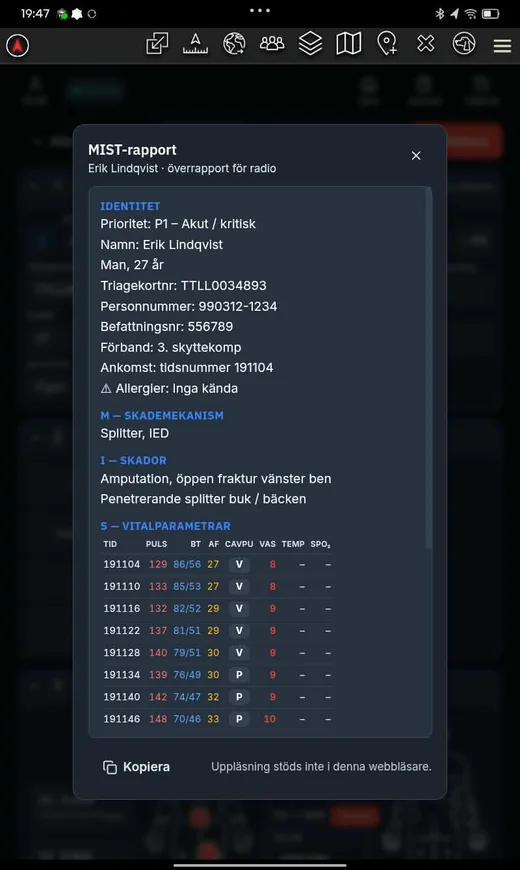
- Finished report A summary of all actions taken and documented.
- Digital casualty card Where all documentation happens.
An example from testing
During user testing we noticed that you could only add one tourniquet per limb. That quickly became a limitation, and you had to keep the time in your head. So we adapted the treatment section to keep a more detailed history.
Before
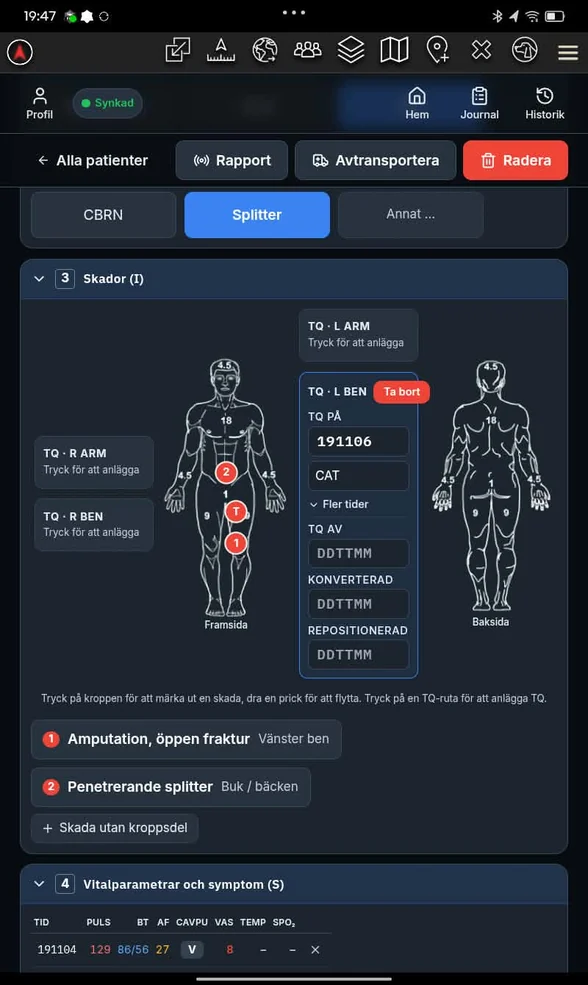
- Time before Only the start time. The rest you had to keep in your head.
- Tourniquet before One per limb, and it was recorded among the injuries.
After
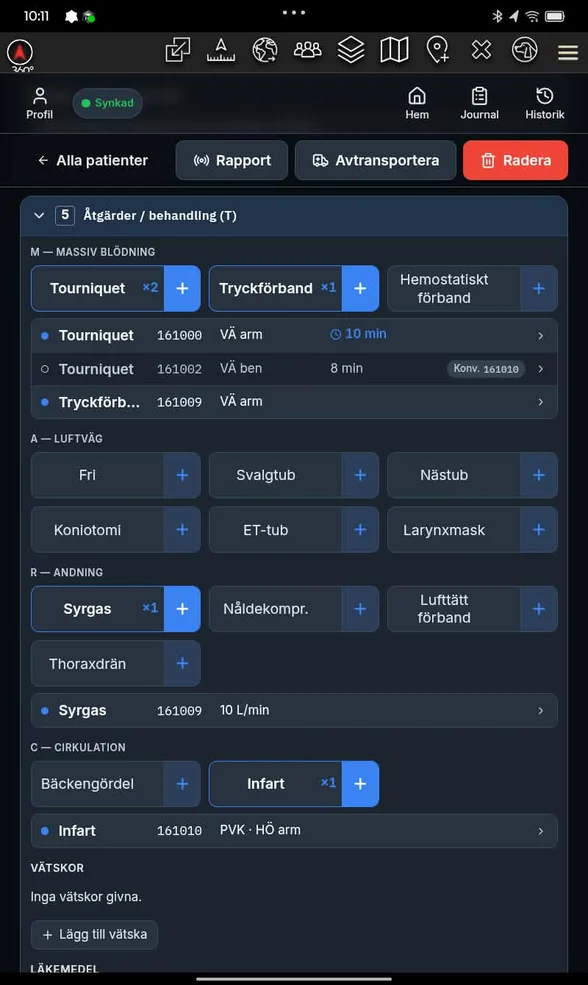
- Tourniquet after As many as needed, under Actions.
- Time after Tracked automatically.
- Conversion Conversion and repositioning get their own time.
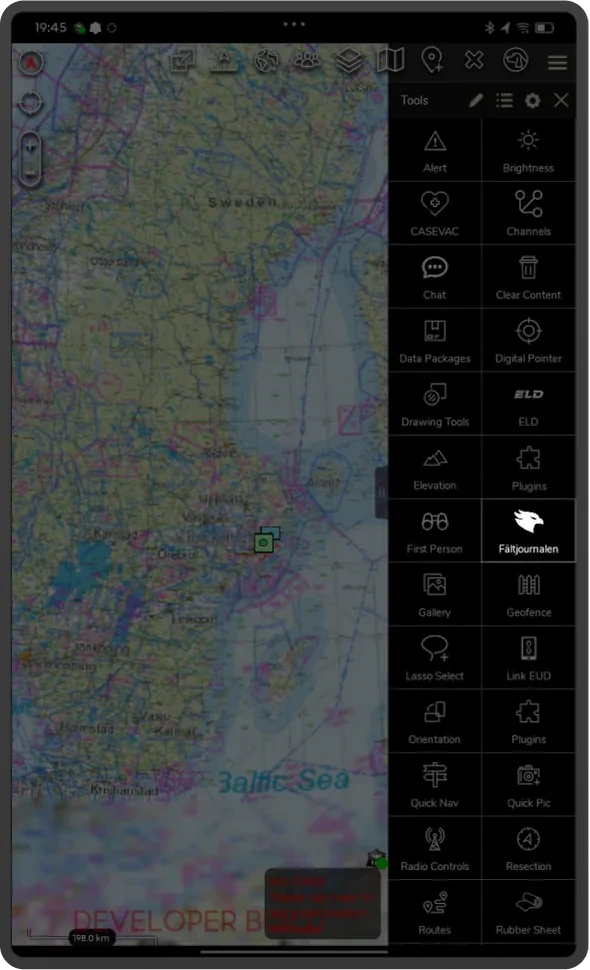
Other features
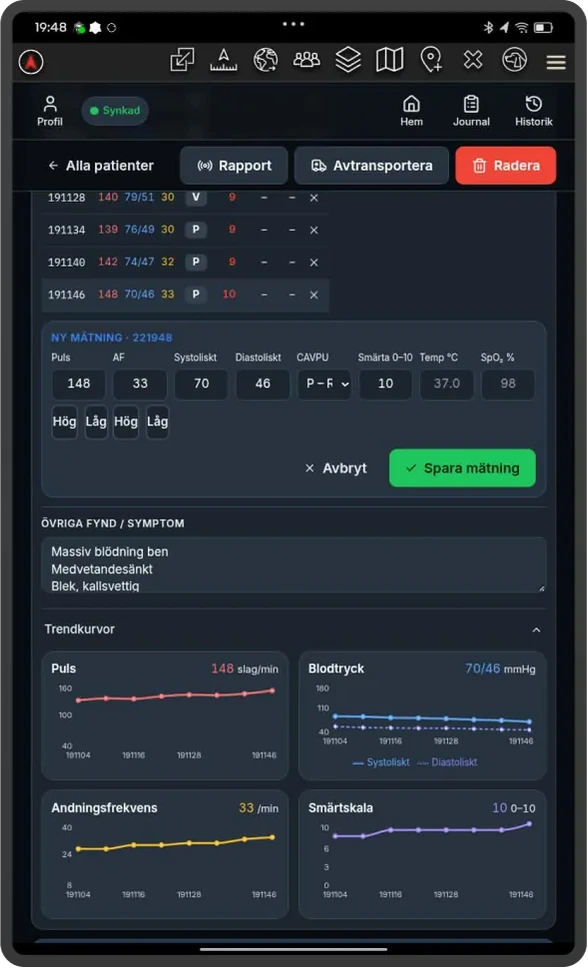
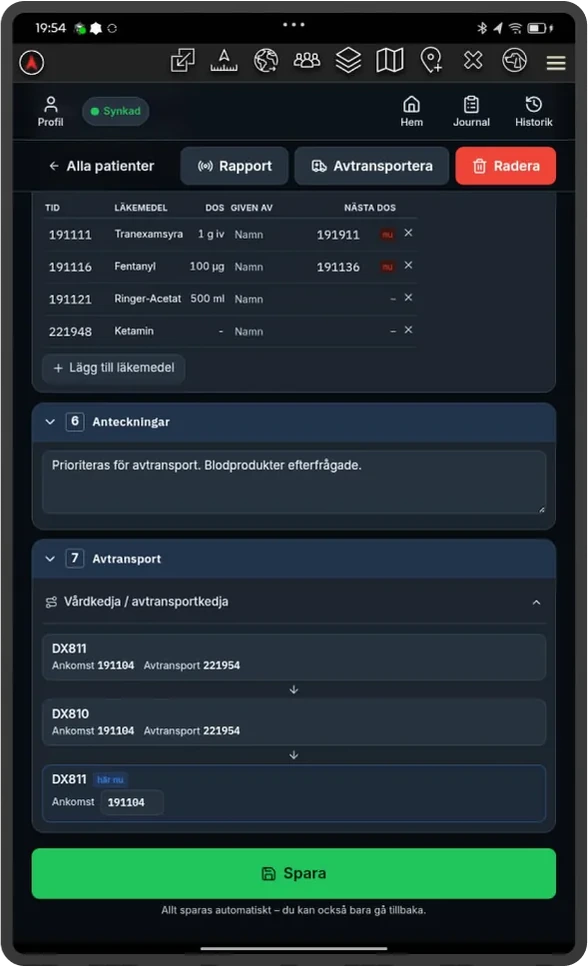
More views from Fältjournalen, from registration to history.
06 Demo Day & media
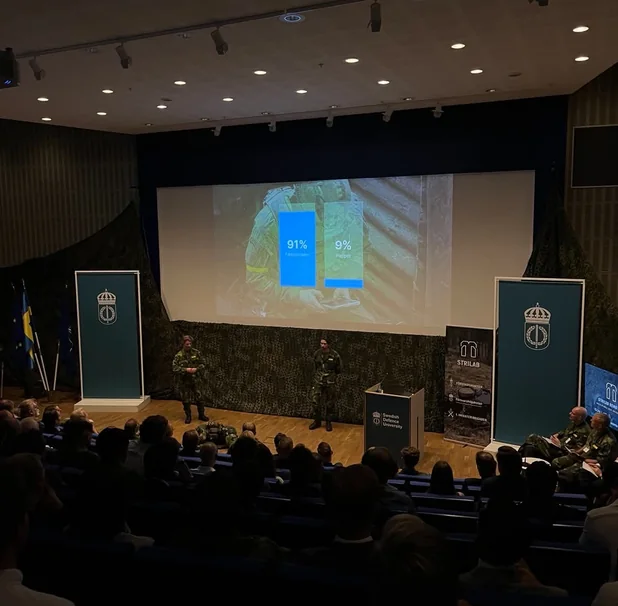
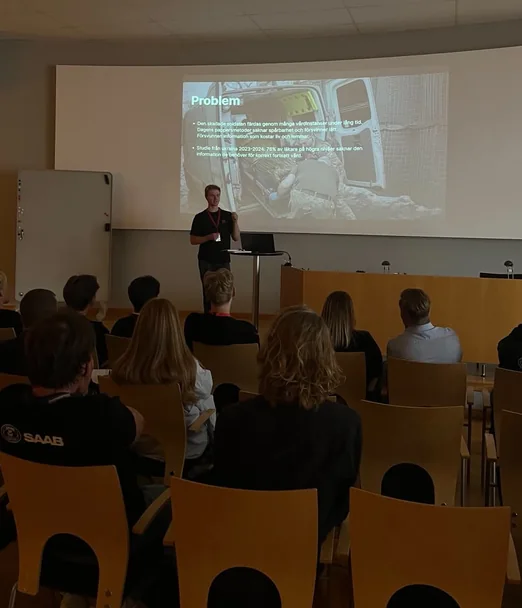
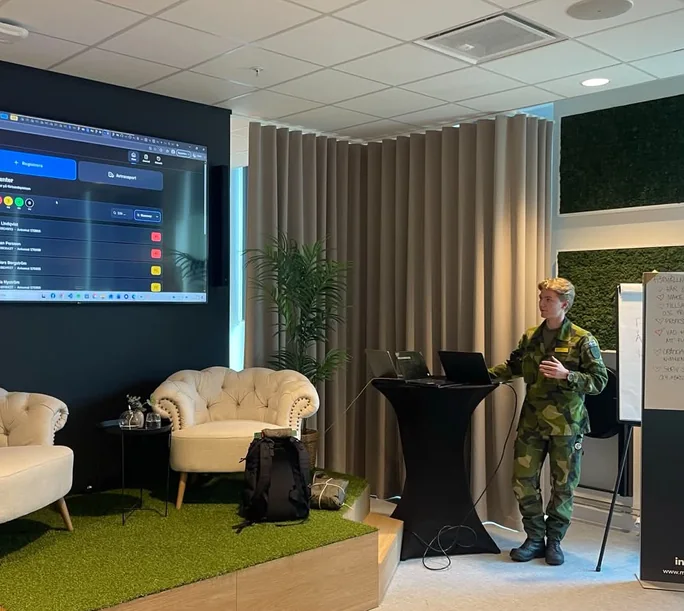
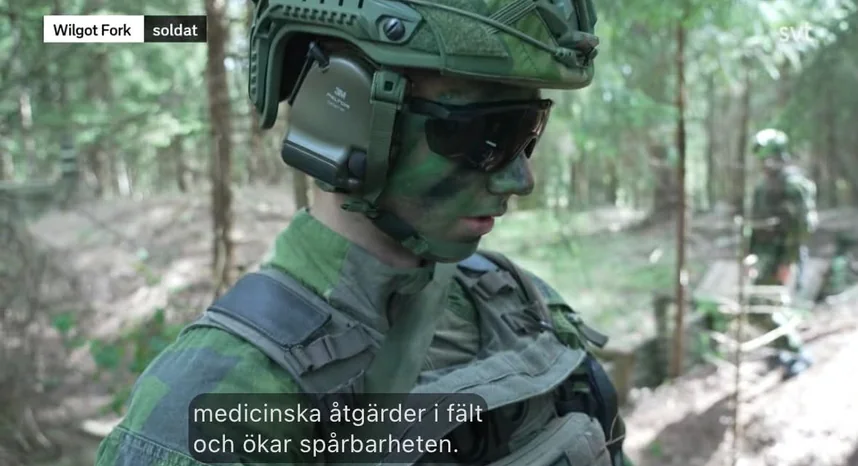
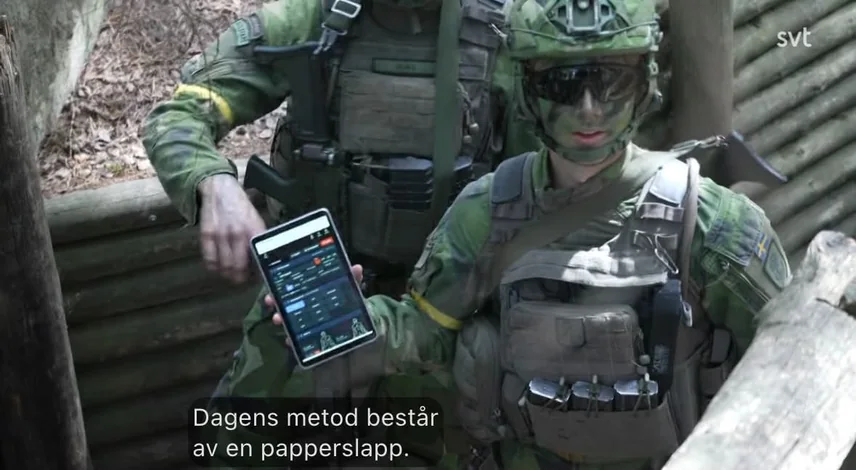
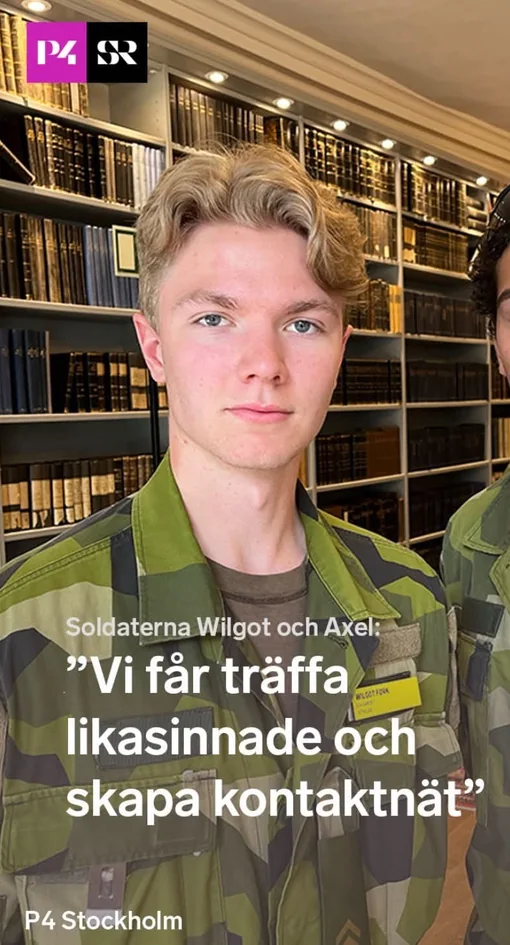
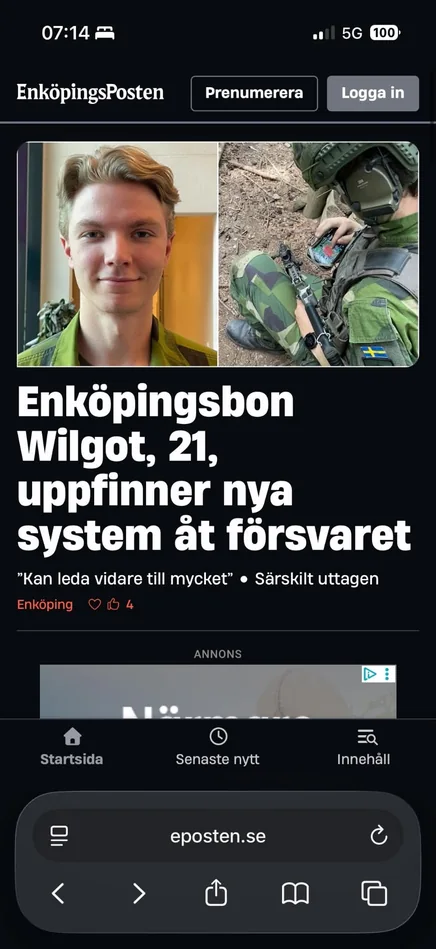
Fältjournalen was pitched at STRILAB’s Demo Day at the Swedish Defence University to 150+ people from the Swedish Armed Forces, government agencies, industry and investors, with the Supreme Commander as guest of honour. The interest led to new partners and testers, demonstrations for units and medical schools, and features in SVT, P4 and Enköpings-Posten, among others.
07 Status & next steps
Problem identified
During the spring exercise series.
Discovery
Before STRILAB.
STRILAB
Five weeks: build, iterate, test and train.
Now
Testing and exercises in units, and further development towards implementation.
Future
A live system integrated with civilian medical records systems.
08 Lessons learned
The hard part is no longer building, but implementing and maintaining something in a large organisation. Being an end user myself helps a lot, but I can’t let that make me blind to my own work. The tests showed that what I take for granted isn’t always obvious to others, so I validate every change with the users.